World War II greeting card to Kermit Brekke

Amy Vach

Catalog Number: 2009.015.001

Copyright La Crosse County Historical Society

Copyright La Crosse County Historical Society

On June 6, 1944, more than 160,000 Allied troops landed on the beaches of Normandy, France. Gen. Dwight D. Eisenhower referred to the operation as a crusade in which “we will accept nothing less than full victory.”

More than 5,000 ships and 13,000 aircraft were involved in the D-Day invasion, and more than 9,000 soldiers were killed or wounded. Their service was not in vain, as more than 100,000 soldiers were able to advance across Europe to eventually defeat the Axis powers.

Trempealeau County resident Kermit Brekke enlisted in the Army in 1942, shortly after the United States entered World War II. Throughout the war, Kermit saved correspondence he received from back home. After Kermit’s return, his wife made him a scrapbook containing the cards he received during the war, along with telegrams and other documents about his service. His wife also added newspaper clippings mentioning the war.

The card pictured here is from Kermit’s wife, Evelyn. Evelyn and Kermit were married at an Army training base in 1943. Shortly after their marriage, Kermit was sent to Northern Africa and then to Italy for the duration of his service. Through the Italian campaign, Kermit’s division marched north and drove the Germans out of Italy.

This card is unique because it’s not solely a card from his sweetheart — it’s also a good luck charm. The outside of the card has a four-leaf clover tied with a red, white and blue ribbon onto the front. The card states that the clover was grown in Balboa Heights, Canal Zone.

The inside of the card says: “I think about you all the while and you should know I do because you know the love Sweetheart I cherish just for you. And while you’re serving Uncle Sam I hope the CLOVER here will help to bring you Luck each day till your returning dear!”

The card is then signed “Your sweetheart Evelyn 11/2/42”

This card predates D-Day by a few years, but it still is reminiscent of this memorable period of U.S. history. Although Kermit was not directly involved on the Normandy beaches, his service as a rifleman, radio operator and repairman were critical to the Allies’ efforts.

This article was originally published in the La Crosse Tribune on June 3, 2017.

This object can be viewed in our online collections database by clicking here.

Ellen Hixon’s soup tureen

Copyright La Crosse County Historical Society

Copyright La Crosse County Historical Society

Peggy Derrick

There was a time when I really wanted a soup tureen. I imagined how beautiful it would look in the place of honor on the table. A soup tureen is very evocative of hospitality. Even though now I think more about where I would store it, and wonder whether the soup didn’t just get cold before it was eaten, I still love a beautiful soup tureen.

This is one of two soup tureens in Gideon and Ellen Hixon’s house, and one of eight covered serving dishes of all kinds. They range in size from a platter that my 1-year-old granddaughter could fit on to a pint-size dish that might hold the cranberry sauce. This middling-size tureen holds about a gallon of soup.

There are two sets of china in our historic house museum, one Limoge and the other Spode. Here at the Historical Society we refer to them as the “good” china and the “everyday” china. This is the “everyday,” and by that we obviously do not mean to compare this to a set of ironstone dishes bought at Target or your mother’s Corelle. It is an older set of china that Mrs. Hixon replaced at some point with the newer and more fashionable Limoge. By the end of the 19th century these bright colors and busy patterns were being replaced with more delicate designs and paler, a more modern palette.

From the beginning of the 19th century the English ceramic manufacturer Spode was producing beautiful reproductions of Japanese Imari ware, which were often in primarily iron red and cobalt blue, like this tureen. The journey of a design influence can be fascinating and complex. Japanese Imari patterns were heavily influenced by contemporary textile patterns, and the most common natural dyes in the era were red and blue.

The large, imaginative floral design also reflects Indian textile designs. The Chinese were the first to admire and imitate Imari ware, and their imitations flooded the European market at a time when Japan had shut itself off from the rest of the world and was not trading. European china was a prestigious home furnishing in the United States, and so we have Ellen Pennell Hixon acquiring this lovely set sometime after her marriage to Gideon Hixon in 1861. I doubt very much that she was thinking about global trade routes or the history of the European ceramic industry when she set her table, yet her dishes made her a part of world history.

This tureen has a secret, which is right out there in the open but which I did not notice for some time. Last winter I gave a presentation to the Hixon House docents, or guides, on the Japanese ceramics in the house, and I used this tureen as an example of Japanese influence on European manufacturers. I handled the tureen to photograph it, put the image in a PowerPoint presentation, and then I talked at length while showing it on the screen during my talk. It was only after several minutes that I suddenly focused on the large cracks and the stitches running across them. I was amazed to realize that we were actually looking at an item that been broken into at least three pieces and repaired — and no one had noticed! The mending staples, or stitches, of wire are clearly visible across the front, and a slight discoloration from glue can also be seen along the crack line.

There’s no telling now when this occurred, or whether it happened during Mrs. Hixon’s lifetime or after her death. It may have been broken and mended during the first decades of the Historical Society’s tenure. Or maybe it was one of those college girls who lived in the house when it was a women’s dormitory in the 1940s. It’s a secret we may never know the truth about, but I am grateful the tureen was mended with such expertise and that it is still here for us to enjoy.


This article was originally published in the La Crosse Tribune on May 27, 2017.

Ellen Hixon’s garden

Peggy Derrick

Copyright La Crosse County Historical Society

Copyright La Crosse County Historical Society

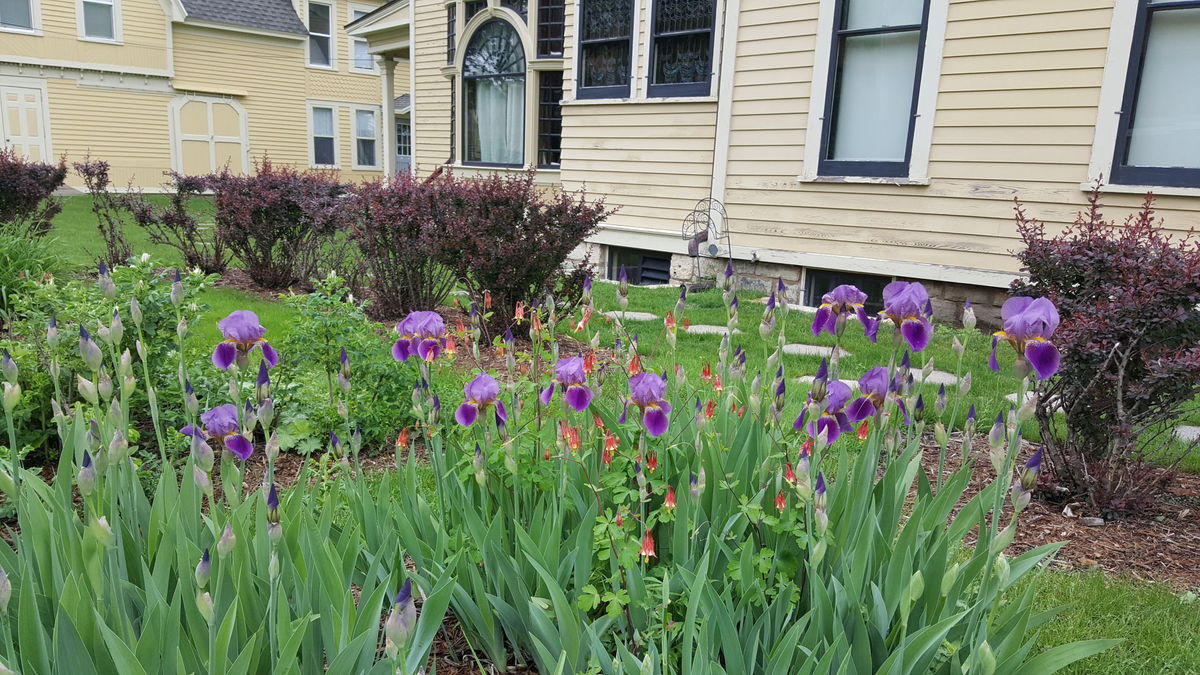
Most of the time we try to preserve historic artifacts by storing them in acid-free conditions and inside rooms with controlled temperature and humidity. But this week’s artifact is left in the dirt, exposed to the elements, and gets water and composted manure dumped on it. That’s because it is a garden, Ellen Hixon’s rose garden, to be exact.

For many years after Hixon’s death in 1913, her gardener, Henry Puent, continued to maintain the grounds in the manner in which she had taught him.

The La Crosse County Historical Society’s major Hixon House restoration project in 2004-05 included research by a landscape historian who studied Hixon’s letters, old photographs and the remains of flower beds to confirm the original form of the formal flower garden on the south side of the house, as well as the varieties of roses, peonies, dahlias, irises and other flowering plants that either had been grown, were still there or would likely have been there.

We know that Hixon was passionate about her garden. She was a member of the local Northwestern Horticultural Society and reported to the group about which varieties of roses and other perennials she found were suitable for the La Crosse climate. Her report reached a conclusion that many northern gardeners will recognize:

“After many experiments and repeated failures with ‘novelties’ with high-sounding names and beguiled by flattering descriptions, we are forced to admit the fact of a soil and climate adverse to the cultivation of any but the most hardy, and we might add, common, varieties, and that ‘eternal vigilance’ is the price of success.”

Hixon grew hybrid roses, which were dug and stored each winter, in the greenhouses at Oak Grove Cemetery. But she also grew hardy, own-root roses — along with peonies and irises — all of which grow in profusion in the garden today, according to the plan produced by the landscape historian, Peggy Beedle.

Most of the plantings are flowers that bloom from late May through June — the garden will never look lovelier than it does in these next few weeks. There is no better time to visit the house than when Hixon’s roses and peonies are in full bloom.

In April of 1907, when she was on a trip to Europe, Hixon wrote home to a friend, “I have visions of my garden waking from its winter sleep, and it is a great magnet.” At this time of year, it is especially poignant to imagine her presence among the awakened beauty in this garden.

This article was originally published in the La Crosse Tribune on May 26, 2017.