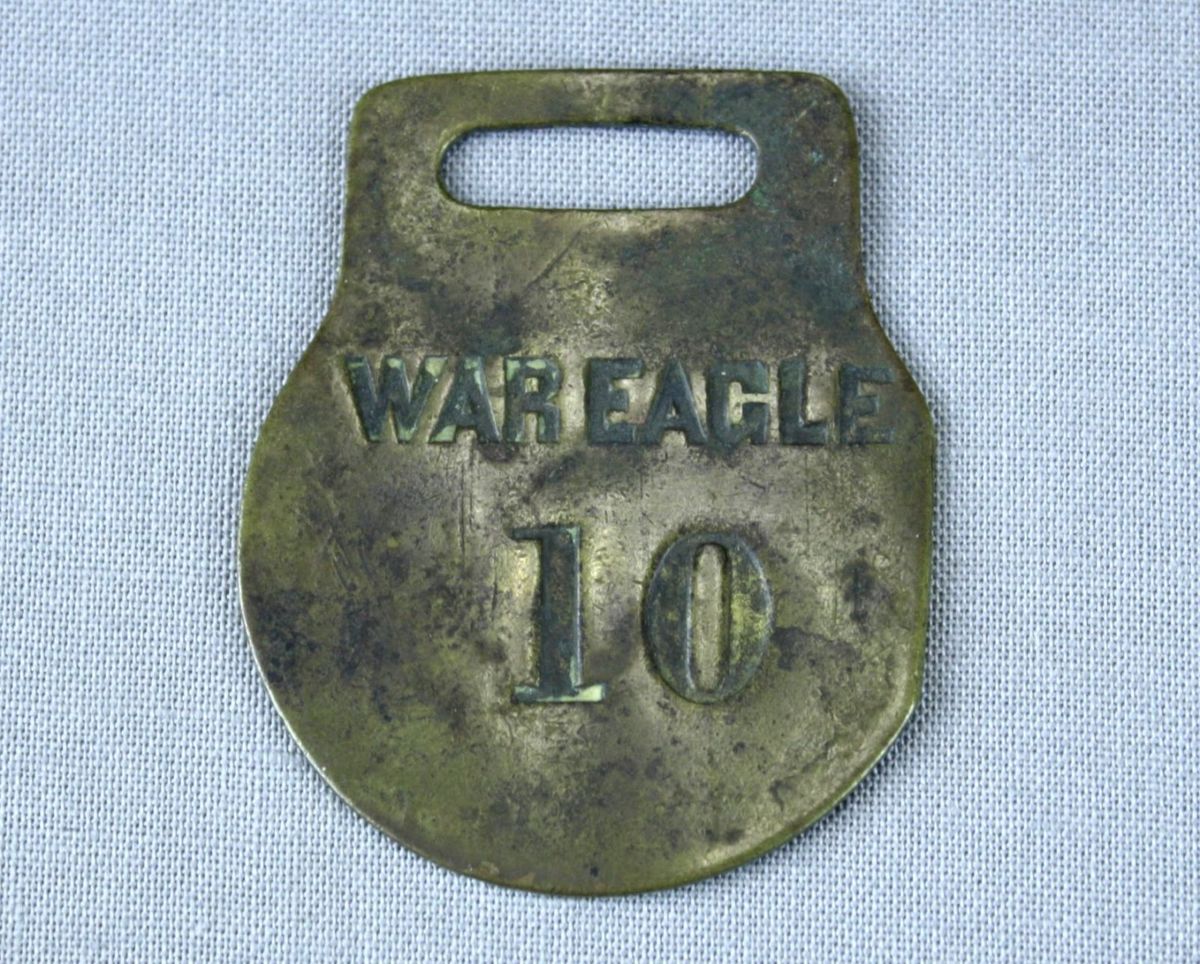
Steamboat War Eagle baggage tag

Robert Mullen

Catalog Number: 1947.001.07

Somewhere, somebody has a claim to some very old luggage sitting at the bottom of the Black River at La Crosse. All they need to prove their ownership is to produce a baggage slip from the steamer War Eagle, dated May 14, 1870, for item No. 10.
Copyright La Crosse County Historical Society

Copyright La Crosse County Historical Society

That date was the evening that the Steamboat War Eagle burned and sank at the riverbank just north of today’s Riverside Park. Along with the boat, the fiery disaster destroyed the docks, the Milwaukee and St. Paul Railroad depot, several freight warehouses and grain elevators, and a passenger train nearby. At least five people died.

In addition, most of the personal effects of the approximately 40 passengers were left behind during the frenzied escape from the burning boat. The staterooms on steamboats were small, so most belongings had been checked and stored in baggage compartments. Oscar Topliff, the vessel’s assistant baggage manager, saved some luggage under his care that night, but not that of at least one unlucky passenger.

This brass tag was strapped to that property. Stamped WAR EAGLE 10, the 1¾-inch high tag had a slot for a leather strap that Topliff had attached to the baggage, a common practice on steamboats and railroads of the day.

Sixty-one years later, in 1931, the Black River dropped to a record low stage, and many local residents were able to wade into the water and pick souvenirs from the charred remains of the War Eagle. This tag was one of them.

Who knows what treasures from 1870 it represents? Perhaps it was an immigrant trunk full of clothing, books and some precious mementos, or perhaps a craftsman’s toolbox. Or a traveling salesman’s patent medicines. Whatever it was, it’s still waiting to be picked up, in damaged condition, at the bottom of the Black River at La Crosse.

The La Crosse County Historical Society has hundreds of additional items salvaged from the War Eagle on exhibit at the Riverside Museum in Riverside Park. The museum is open from 9:30 a.m. to 4:30 p.m. Mondays through Saturdays and 10 a.m. to 4 p.m. Sundays.


This article was originally published in the La Crosse Tribune on April 22, 2017.

This object can be viewed in our online collections database by clicking here.
Black River log drive

Robert Mullen

For the Black River logging industry in the 19th century, springtime was time for a drive. This drive was not a pleasant outing in the country — it was a cold, wet and dangerous movement of logs downstream from the northern reaches of the river to the sawmills in La Crosse and Onalaska.

Copyright La Crosse County Historical Society

Copyright La Crosse County Historical Society

The lumber industry was the biggest business along the Black River from 1850 to 1900. During the winter months, thousands of trees were cut down in the forests of Jackson, Clark and Taylor counties and pulled by oxen and horses to the banks of the frozen river and its tributaries. In spring, the waiting logs were rolled into the rising streams and floated to the mills downstream.

The logs floated down with the current, assisted by log drivers, men who poked and prodded the logs away from the banks and islands, or out of shallow waters. The drivers worked from shore or from small boats, and some balanced on the floating logs, trying to keep everything freely flowing.

It was risky work, and the drivers frequently took spills. Dunks were a daily occurrence, that sometimes resulted in drowning.

Each spring, tens of thousands of trees that measured many millions of board feet were floated downstream. With so many logs crowding the river, the driver’s efforts could not always prevent a logjam.

Logjams could form quickly and sometimes piled several stories high and several miles long. Slowly, log by log, the drivers loosened key logs and got everything moving again.

Each log was stamped with its owner’s mark. When the long journey ended, logs was sorted into separate holding areas for the various mills to await the saw blade or to be made into a large raft to continue farther down the Mississippi River to a more distant mill. By late spring or early summer, most of the logs had been delivered to their destinations.

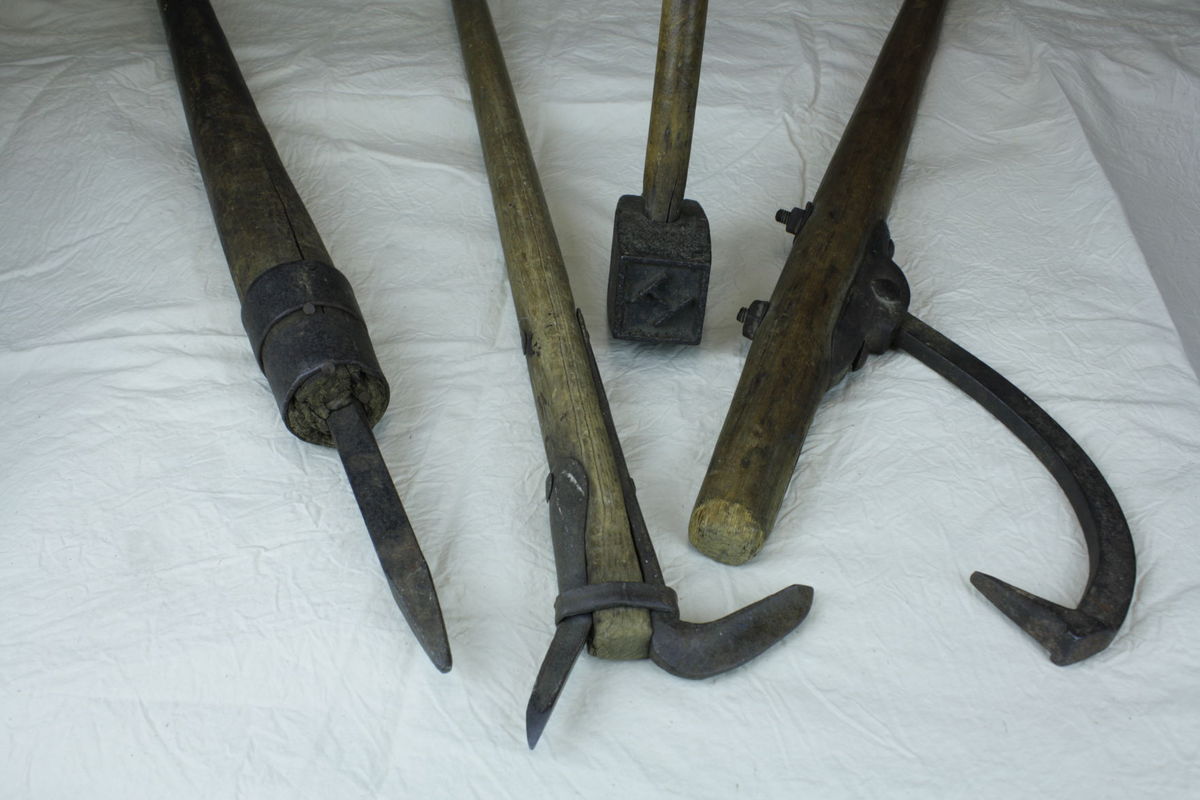
The La Crosse County Historical Society owns some of the tools used on the drive. Shown here are two variations of pikes, left, wrought iron points mounted on long handles used to steer and prod the logs. On the right is a cant hook, a tool used to grasp and roll a log. The cast iron hammer head is pounded into the end of the log, impressing it with its owner’s symbol. In this case it is an “H” inside a diamond, indicating the Holway Mill in North La Crosse.

Logging artifacts like these can be seen at Riverside Museum. 

This article was originally published in the La Crosse Tribune on April 15, 2017. 


Campaign buttons of presidential losers

Amy Vach

The La Crosse County Historical Society has thousands of buttons — literally thousands. Some of them are from Oktoberfest, others are from local businesses or events, and even more are from elections.

Most of the campaign buttons are from local elections, whereas about a hundred of the buttons are from presidential elections.

The oldest presidential campaign button in the collection is from 1876 and the most recent is from 1992. While cataloging the presidential campaign buttons, unfamiliar names were revealed. It became clear that the unfamiliar names were those who lost.

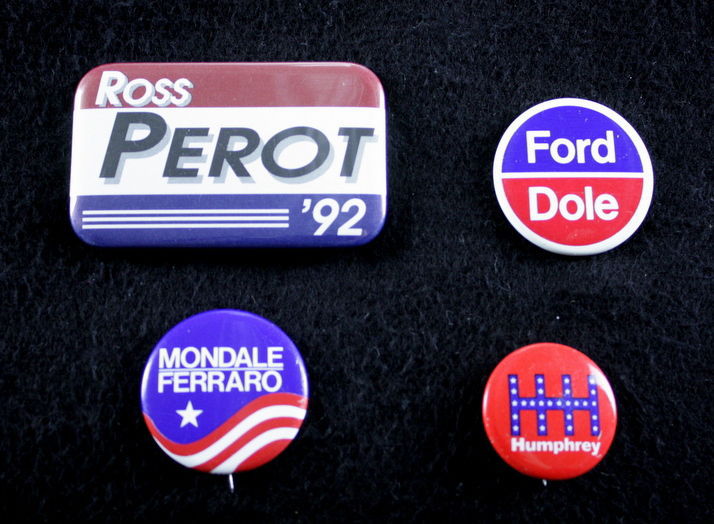
The image depicts the campaign buttons of:

Copyright La Crosse County Historical Society

Copyright La Crosse County Historical Society

Ross Perot, 1992 independent candidate for president

Gerald Ford, 1976 Republican candidate for president

Walter Mondale, 1984 Democratic candidate for president

Hubert Humphrey, 1968 Democratic candidate for president

Going into a presidential election, candidates know that there are one of two options: Either they will become the next president of the United States or they will walk away defeated, having tried their best.

Many presidential candidates have gone on to other elected office, such as governor and senator. Richard Nixon did not let an initial defeat keep him down. After losing to John Kennedy in 1960, he waited a few years and ran again in 1968 — and won.

Others have sought to champion the causes that led them to run for president in the first place. And other candidates have gone on to establish beneficial public institutions. New York seems to have benefited the most from this, with the Erie Canal, the New York Public Library and even the Empire State Building.

Having a collection of campaign buttons of those who lost is not an insult or in any way dismissive of the candidates’ efforts. The collection is meant to honor those that tried to become president. Running an election campaign is not an easy task, and these candidates gave it their all — some more than once.

These buttons and others from the La Crosse County Historical Society’s collection can now be viewed online at lchshistory.pastperfectonline.com.


This article was originally published in the La Crosse Tribune on April 8, 2017.