Quincy Hale's Baseball Cleats

Amy Vach

Catalog Number: 1987.032.01

Copyright La Crosse County Historical Society

Copyright La Crosse County Historical Society

Spring is here, the weather is warming, and it’s time to dust off those gloves and take part in the nation’s pastime: Major League Baseball’s return on Sunday.

La Crosse County Historical Society has an extensive footwear collection, which includes this pair of baseball cleats from 1910 that belonged to Quincy Hale, used while he was playing high school baseball.

Hale was a widely known La Crosse lawyer and community figure. He graduated from the University of Minnesota with a law degree in 1918. That same year, Hale joined the Army Air Service and began training in Texas. Hale’s training was not completed before the end of World War I, so he returned to La Crosse and joined the law firm of Hartwell & Cowie. In 1923, he married Helen Wilson. The Hales had three daughters: Jane, Molly and Helen.

In 1925, Hale was diagnosed with tuberculosis and went to a sanitarium in Stevens Point, Wis., for treatment. Within a year he recovered and began serving the La Crosse community.

These are just a few of the groups to which Hale belonged: the City Plan Commission, the La Crosse Public Library, the La Crosse County Historical Society, the Pettibone Park Commission, G. Heileman Brewing Co.’s board of directors, and the planning commissions of the La Crosse airport and the Mary E. Sawyer Auditorium.

In 1945, Hale was the first La Crosse lawyer to become president of the Wisconsin Bar Association. He was a lawyer in the La Crosse area for more than 60 years, and he handled the transfer of Hixon House and all its contents from Alice Green Hixon to the La Crosse County Historical Society.

Hale’s cleats were donated to historical society in 1987 by his daughter, Helen Thiesen. His daughter thought that the cleats were used while Hale attended the old Central High School. Unfortunately, Hale did not come to La Crosse until 1919, after graduating from college and serving in the Army. In fact, he graduated from Spring Valley High School, in Spring Valley, Minn., so his cleats were not used for the old Central High School baseball team.

As important as family stories are, they do not always hold up well against the facts. We may think we know our parents’ history, but mistakes like this are not uncommon.

These cleats have menacing metal spikes, which fell out of favor years ago because of obvious safety problems. Shoes such as these were made of leather and were uncomfortable to wear. Today’s cleats are made of synthetics with plastic spikes that look like running shoes, and are safer and more comfortable.

Although Hale never went on to play baseball professionally, his cleats share the history of a favorite pastime of the nation and of a man committed to serving his community.

This article was originally published in the La Crosse Tribune on April 1, 2017

This object can be viewed in our online collections database by clicking here.

Leech Jar

58d292a5ca4dd.image.jpg

Miranda Socha

Catalog Number: 2017.fic.234

In the long history of medicine, there are many things that make us cringe. Examples include scary dentist tools, electroshock machines and leeches used to treat a variety of ailments.

This week’s artifact, a white ceramic leech jar, dates to about 1850. It was donated by the A. Bellerue Drug Store of La Crosse, which opened in 1880 and closed sometime in the early 20th century.

Leeches have been used in medicine for thousands of years, with the earliest mention of “bloodletting” occurring about 800 B.C. in an ancient Sanskrit text titled “Sushruta Samhita.” One of the most common types of leeches that have been used for medicine is the species Hirudo medicinalis, or the European medicinal leech.

Almost every Old Word culture used these little worms. In Egypt, for example, they were used to treat everything from fevers to flatulence. Leeches are particularly useful in situations where blood flow is necessary, as their saliva contains anticoagulants that lets oxygen rich blood into the wound and promotes healing. In the 1800s, leeches even were used to treat for black eyes, which appears to be the specific use for today’s artifact.

Staring in the 20th century, many doctors shied away from the unappealing idea of using worms on their patients. In 1985, a physician from Harvard University was attempting to reattach a severed ear onto a young child and could not reattach the veins because they kept clotting. By using leeches to take some of the blood from the ear — and using the leech saliva — the ear was able to be saved.

Leeches are used today because of their unique ability to effectively remove blood and keep a wound bleeding. One downside, however, is that sometimes after the leech is full it can unattach itself from the designated area and hide in the patient’s bedsheets.

In 2001, researchers from University of Wisconsin-Madison developed a mechanical leech that never gets full, like traditional worms do, and has the added bonus of not looking like a wriggling worm that can detach at any time, which can be disconcerting for both the patient and the patient’s family.

Leeches are still studied in an effort to better understand their abilities, and some physicians still prefer using live leeches over mechanical versions because they are cheaper and are self-reproducing tools.

Overall, leeches represent a vital part of the continuing history of medicine from around the world as well as the medical collection here at the La Crosse County Historical Society.

This article was originally published in the La Crosse Tribune on March 25, 2017

This object can be viewed in our online collections database by clicking here.
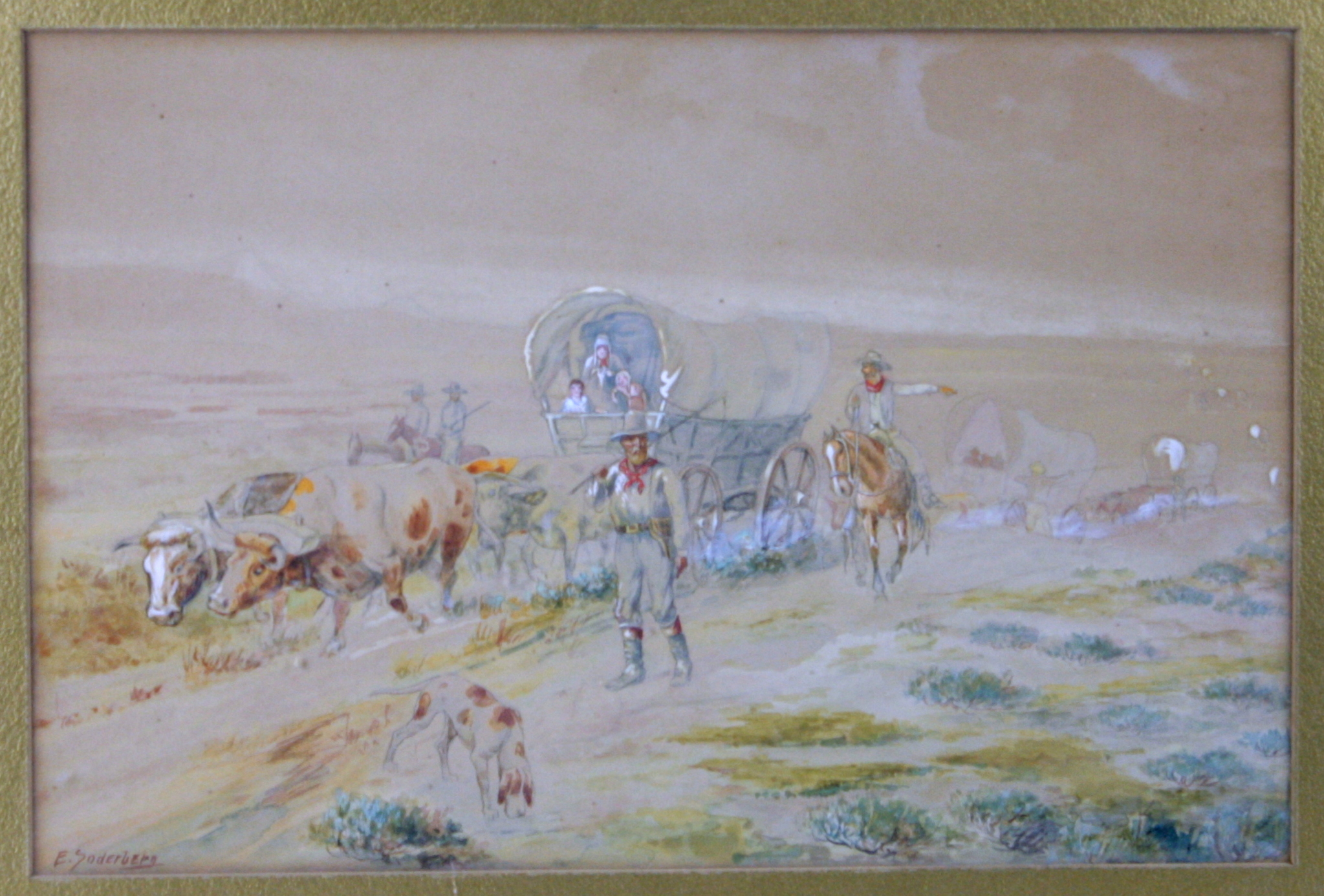
Works by Axel Edward Soderberg and Odin Oyen

Amy Vach 

Catalog Number: 2017.fic.141

Copyright La Crosse County Historical Society

Copyright La Crosse County Historical Society

In the early decades of the 20th century, La Crosse was home to an interior design firm known throughout the upper Midwest. Oyen Designs provided interior decorating, and it also furnished frames, carpets and draperies. The artists who worked there came from different countries, and they worked together to create a renowned design studio.

One of those men, Axel Soderberg, painted this picture.

Axel Edward Soderberg was born in Gothenburg, Sweden, in 1859. He attended the Royal Danish Academy of Fine Art in Copenhagen, and he decorated the Swedish king’s palace in Uppsala. In 1893, Soderberg immigrated to the United States to decorate buildings for the Columbian Exposition in Chicago.

Odin J. Oyen was born in 1865 in Trondjem, Norway. His family immigrated to Madison in 1870. He attended the Art Institute in Chicago in 1883 and, after graduation, he moved to La Crosse. In 1888, Oyen joined Louis Nelson to form Nelson & Oyen, an interior design firm. In 1890, the men decided to dissolve the firm and go their separate ways. A year later, Oyen started his own interior design firm and hired his father and brother as painters.

In 1903, Soderberg joined Odin Oyen’s decorating firm in La Crosse. Oyen enticed Soderberg from a job opportunity at a competing decorating firm in Clinton, Iowa. Soderberg is described as the most significant artisan of Oyen. Together Oyen and Soderberg were a phenomenal team. Both men were immigrants, and part of their success and teamwork may have been because they had similar artistic techniques and wanted to succeed in their new homes.

Oyen’s firm specialized in murals and interior designs in buildings, such as churches, banks, hotels, clubs, hospitals, libraries, courthouses, schools, theaters and breweries.

The La Crosse County Court House, which opened in 1904, was decorated by Oyen and Soderberg. The murals on the inside of the dome, the grand staircase and the circuit courtroom were primarily the work of Soderberg.

Soderberg worked with Oyen until his death in 1922. Shortly after, in 1926, Oyen died, and his business was carried on by Louis Nelson and Oyen’s son Leighton. The firm dissolved in 1931 during the Great Depression, when the number of business contracts declined. Part of this decline was due to stylistic changes with which the firm could not keep up.

This painting by E. Soderberg shows the teamwork between Soderberg and Oyen. There is a small blue sticker on the back from Oyen’s Art Store at 114 S. Fourth St. It is a mix of gouache and watercolors, and it depicts pioneers on their journey westward in covered wagons. More than likely it was a study for a large mural commissioned for a public building.

Oyen and Soderberg’s work can still be viewed in various institutions across the Midwest.

This painting represents a partnership between two immigrants who created art in numerous buildings. It was intended to recognize pioneers and western expansion, but more importantly for us, it also tells the story of two Scandinavian artists who together built their careers and homes in the young city of La Crosse. For this, it is treasured in the La Crosse County Historical Society’s collections.

This article was originally published in the La Crosse Tribune on March 18, 2017.

This object can be viewed in our online collections database by clicking here.