Irish shillelagh

Amy Vach

Catalog Number: 1915.012.01

La Crosse has been home to Irish immigrants since its early days of white settlement.
Copyright La Crosse County Historical Society

Copyright La Crosse County Historical Society

In 1854, 16 of the 745 residents of La Crosse were born in Ireland. Today roughly 300,000 residents of Wisconsin claim Irish ancestry. Although the percentage of individuals declaring Irish ancestry has decreased, the presence of Irish heritage in the community has not diminished.

The Shamrock Club of Wisconsin was created in 1960 by people who desired to promote and keep Irish heritage alive. A local chapter — the Greater La Crosse Area Shamrock Club Inc. — was formed in 1973. Since the 1960s, this club has become one of the largest ethnic organizations in Wisconsin.

In La Crosse the organization is responsible for many Irish events, especially the St. Patrick’s Day Parade and Irishfest. The club describes itself as an organization stressing the cultural, social and charitable aspects of Irish heritage, and its members encourage everyone to join — you don’t have to be of Irish descent to be a member.

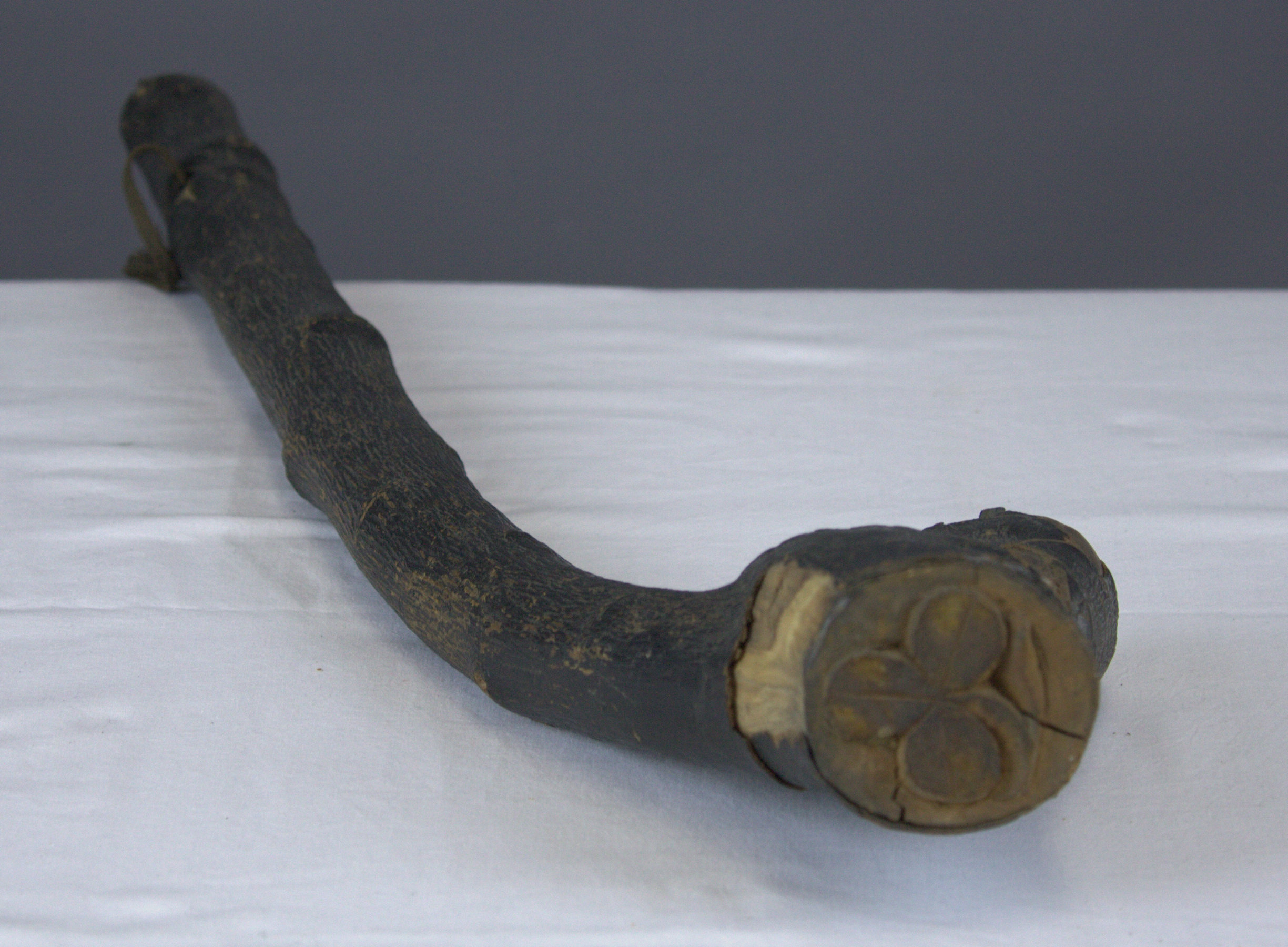
A shillelagh (pronounced shuh-ley-lee) is is a wooden walking stick and club or cudgel, typically made from a stout knotty stick with a large knob at the top. Shillelaghs are typically made of blackthorn. According to legend, King Richard II is credited for referring to the stick as a shillelagh. The name actually referred to the people living in the village of Shillelagh and Shillelagh Forest in Ireland during the 14th century who used the sticks as weapons.

Although shillelaghs have a violent history, today they are used as walking sticks and are seen as a symbol of Irishness.

This shillelagh has been in the La Crosse County Historical Society’s collection for more than 100 years. It was donated in 1915 by Mary H. Parks. This stick is made of knobby wood and has a clover relief carving at the top. Below the clover, a ribbon design is carved into the head of the stick and says “ERIN,” the Gaelic word for Ireland.

This article was originally published in the La Crosse Tribune on March 11, 2017.

This object can be viewed in our online collections database by clicking here.
Bicha Fur Advertising Sign

Robert Mullen

Copyright La Crosse County Historical Society

Copyright La Crosse County Historical Society

Catalog Number: 1984.026.11

Fur is one of the oldest materials people have used for clothing. It was worn by prehistoric humans, and it continues to be used today. Furs have been worn as a necessity for warmth, for decoration and for the glamour has provided in some eras.

The first Europeans living in the upper Mississippi River valley came to trap and hunt the abundance of fur-bearing animals living there, supplying the voracious European appetite for fur during the 18th and 19th centuries. By the 1840s, the early settlers in La Crosse traded for furs from native and European trappers.

A modern form of the fur trade continues today, though the fur business has become a controversial subject.

La Crosse was home to several retail furriers over the years, the most recent being Bicha Furs, at 113 N. Third Street. Joseph Bicha joined the long-established Charles Sharna fur shop in 1915. Bicha had previously learned the craft of making fur clothing from furs as an apprentice, probably working with Sharna. By 1922, Bicha had his own shop, making and selling coats, shawls, wraps and hats for many years in his downtown location.

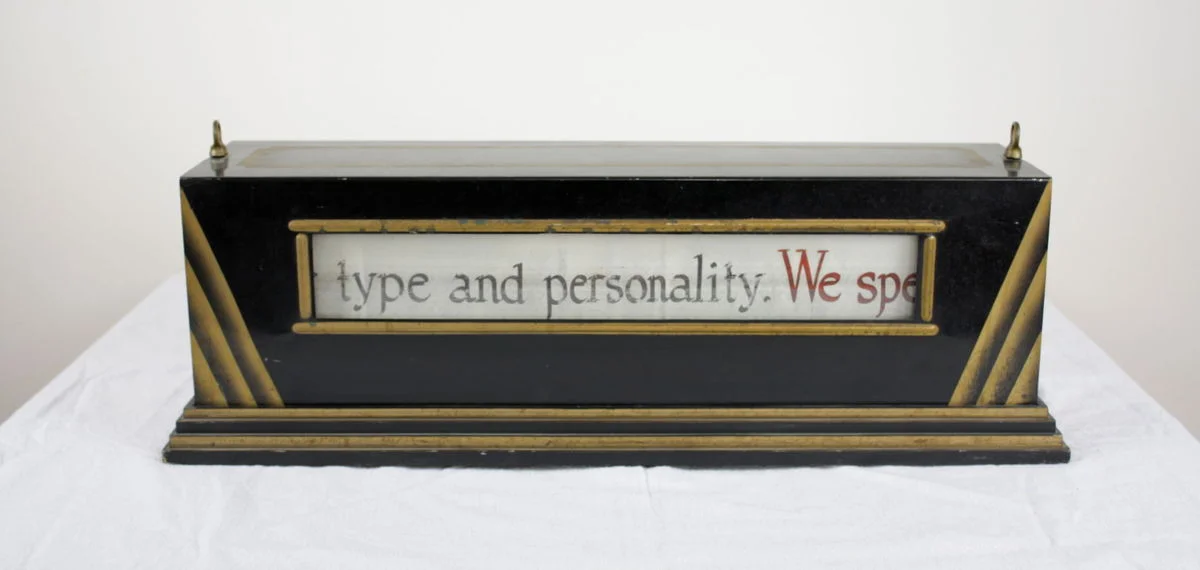
The mechanical sign shown here was used in Joseph Bicha’s fur shop as advertising for the proprietor’s custom-made coats. It is a black-and-gold metal box painted in the art moderne style of the 1930s and 1940s. It has a glass pane across the front and houses a small electric motor that turns a continuous hand-lettered streamer: “We specialize in custom made coats. A fur coat is the most becoming garment for any woman if designed to fit her type and personality.”

This early use of electrical advertising likely hung in the store’s window to attract potential customers.

Joseph Bicha’s son Edward began working in the store by 1950, and he was named manager in 1958. Edward continued the business until 1984, when he retired. By then, he advertised both fur and cloth coats for sale. Edward Bicha was the last retail furrier in the city.

This article was originally published in the La Crosse Tribune on March 4, 2017.

This object can be viewed in our online collections database by clicking here.

McCord Wholesale Druggist shipping crate

Miranda Socha

Catalog Number: 2017.006.01

When James McCord was just a student living in Pennsylvania, it was difficult to imagine that one day he would wind up being president of one of the largest wholesale druggists in La Crosse.

Copyright La Crosse County Historical Society

Copyright La Crosse County Historical Society

When he was just 17, and after graduating from the Iron City Commercial College at Pittsburgh, he moved to Sparta, where he taught school during the day and at night and in the mornings kept books. In the the fall of 1858, he secured a job as a full-time bookkeeper for a bank in Milwaukee for several years.

It was this bookkeeper position that would grant him access to the wholesale drug business. In December 1864, McCord moved to La Crosse — and along with J.H. McCulloch and John Rice of Milwaukee — formed the firm of McCulloch, McCord & Co., which would go on to purchase the wholesale drug business of Uriah Parry Jr.

This business was located on North Front Street between State and Main streets, where the 4 Sisters Wine Bar is today. In the years after this purchase, both McCulloch and Rice would withdraw their interests, leaving the business solely to McCord in 1882, and at which time he was made the company’s president.

The business, however, did not stay solely McCord’s for very long. In January 1905, just six weeks after McCord’s death, the company merged with the only other wholesale druggist in La Crosse, T.H. Spence Drug Co., which was founded in 1874. This merger was approved by both T.H. Spence and his son E.W. Spence, as well as A.C. McCord, James McCord’s son.

Although A.C. McCord would resign from his position within the new company as elected secretary after just four months, the newly formed Spence-McCord Drug Company would be around until the early 1970s.

This division in time periods is important to note in regards to this week’s artifact, a shipping crate from James McCord Wholesale Druggist of La Crosse. Due to the name on the crate, we know that it had to have been produced sometime between 1882 and early 1905, although it was likely reused several times based on the wear on the crate.

This shipping crate was donated to the La Crosse Historical Society by George Schultz in 2016 and is an excellent addition to our medical collection here. Although the crate does show slight wear and tear, one interesting thing about the crate is that the original leather hinges are still intact. These were used to attach lid to the rest of the crate so it could not be misplaced, and thus the crate could be returned and reused.

This article was originally published in the La Crosse Tribune on February 25, 2017. 

This object can be viewed in our online collections database by clicking here.