Remembering President Abraham Lincoln

Amy Vach

Catalog Number: 1974.012.05

Sunday is the 208th anniversary of the birth of Abraham Lincoln.

Born in 1809 in a one-room log cabin in Kentucky, Lincoln was a largely self-educated lawyer who served first in the Illinois House of Representatives and then in the U.S. House of Representatives. In 1860, he was elected president of the United States. A few months later, Fort Sumter was attacked by the Confederates, and Lincoln became a wartime president.

Copyright La Crosse County Historical Society

Copyright La Crosse County Historical Society

Five days after Gen. Robert E. Lee surrendered on behalf of the Confederate Army, Lincoln was shot and killed by a Confederate sympathizer. He was the first U.S. president to be assassinated; he had just been overwhelmingly re-elected.

While there were certainly those who celebrated his death, especially white Southerners, most people’s relief and joy over the war’s end quickly poured over into their grief. For decades after his death, it was common for people to hang an image of Honest Abe in their homes. The legacy of this mourning can still be seen in the La Crosse County Historical Society’s collections.

During the Civil War, La Crosse residents Capt. Wilson Colwell and his wife, Nannie, had an opportunity to visit the White House and meet Lincoln and his family. Colwell was the sixth mayor of La Crosse and a captain of Company B, 2nd Wisconsin Infantry, also known as the Iron Brigade, during the Civil War. Company B, along with Capt. Colwell and his family, went to Washington to respond to Lincoln’s call as the first La Crosse contingent of volunteers to serve in the war.

Many years later, Colwell’s widow reminisced about her meeting with Lincoln in the La Crosse Tribune (Feb. 13, 1927). She described the president as a “tall, gaunt, awkward figure, yet lovable and big-hearted.”

This full-body portrait of Lincoln — in his customary suit, bow tie and top hat — captures the Lincoln that Nannie described. It is an etching, produced by an artist carving a design into a metal plate. The plate is then covered in ink and placed into a high-pressure press with a sheet of paper to produce an image.

The signature, “Schneider,” is that of Otto J. Schneider (1875-1946). Schneider is the creator of another, more famous portrait of Lincoln created from a photograph taken by Alexander Hesler. Written in pencil on the back of this print is “February 2, 1913,” possibly the date it was made. The original deed of gift identifies this as a rare Schneider etching. It was donated in 1974 by Mrs. James Polk, a member of the La Crosse Daughters of the American Revolution.

This is one of many portraits of Lincoln that memorialized the man who brought the nation through the bloodiest war in U.S. history. The full Abraham Lincoln collection at La Crosse County Historical Society can be viewed on the society’s website.

This article was originally published in the La Crosse Tribune on February 11, 2017. 

This object can be viewed in our online collections database by clicking here.

This object can also be viewed in our online exhibit "Mourning a Beloved President"
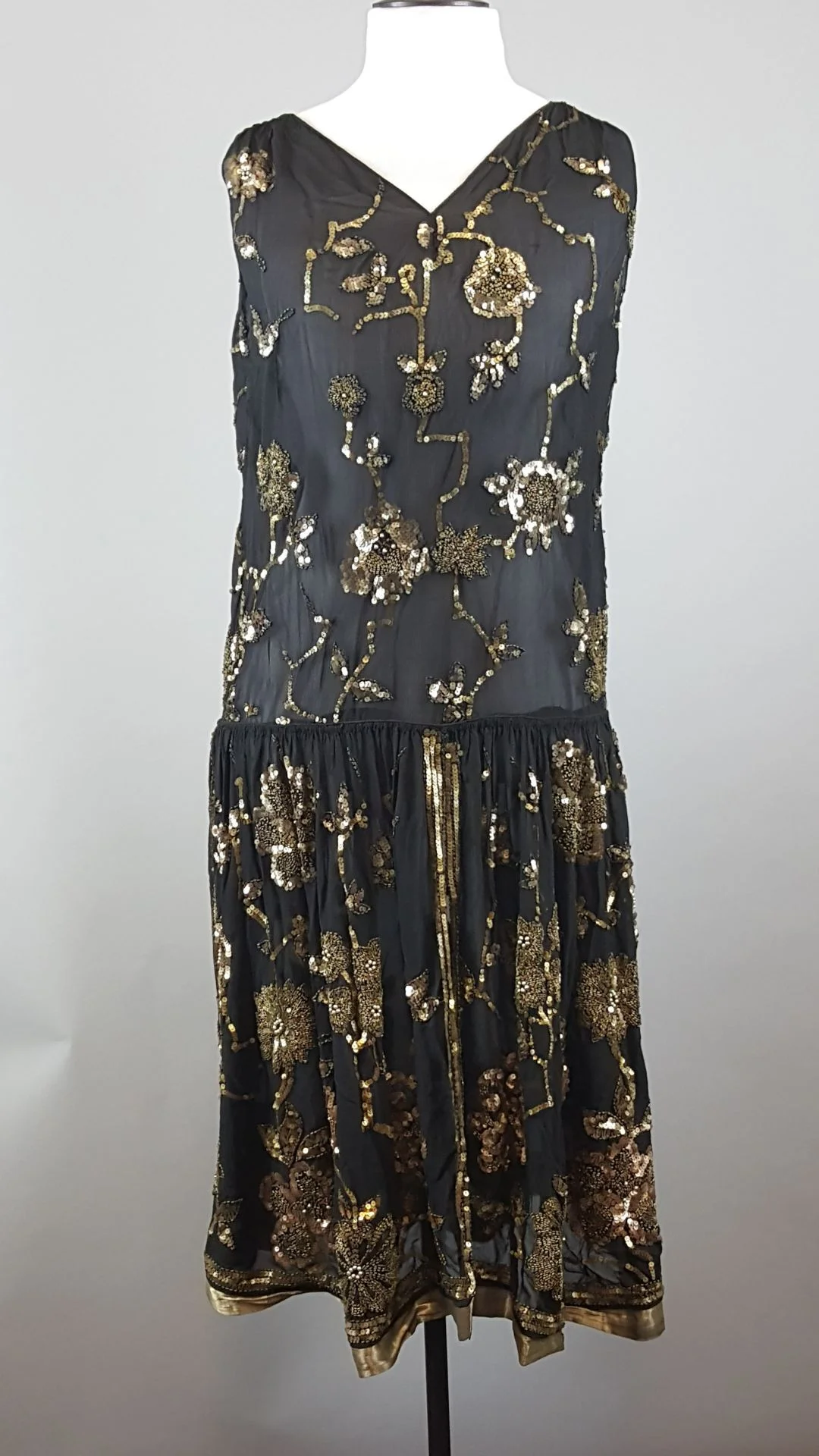
1920s French dress

Amy Vach

Copyright La Crosse County Historical Society

Copyright La Crosse County Historical Society

Catalog Number: 1978.025.09

How did a 1920s “high fashion” French dress find its home in the La Crosse County Historical Society’s textile collection? It is a fascinating journey.

This gorgeous dress was donated by the late Barbara McMahon in 1978. The sleeveless, drop-waist dress is a black silk chiffon, covered with floral designs of metallic sequins and tiny metal beads. Their colors darken from silver at the neckline to copper, gold and bronze as the complex design flows down to the bottom hem. (Trust me: The photo doesn’t do it justice.)

The label inside reads “Haute Couture Henry Gallet, Paris 9. Rue de Conde.” McMahon was born in 1923, so she was too young to wear this glamorous dress in the Roaring 1920s. So who did wear it?

McMahon’s parents were Frank and Gertrude Lahm. Frank, a brigadier general, was the first military officer of the U.S. Air Force to fly in an airplane, and he trained directly with Wilbur and Orville Wright. He was stationed in Paris as air attache to France, Spain and Belgium. Gertrude contracted pneumonia in 1931 and died before Frank returned home from Paris, leaving behind an 8-year-old Barbara.

Barbara’s cousin, Mary McConnell, brought Frank and Gertrude’s children, Barbara and Lawrence, to Europe to be with their father. The children stayed in Europe until Frank’s career shifted again, and he became the chief of aviation, First Army, at Governors Island New York. When the family returned to New York, Barbara married Robert Emmett McMahon in 1942. At some point the McMahons moved to La Crosse and settled down. Robert worked at Grandview and Gundersen clinics in internal medicine.

Based on the family’s travels, we can assume that this dress was owned and worn by someone in Barbara’s family and was held onto as a family memento. Her mother, Gertrude, would have been a young married woman when this dress was fashionable, and she had the means to afford its haute couture price tag, as well as a husband stationed in France who could have purchased it for her.

It also makes sense that Barbara, who lost her mother at an early age, would have saved keepsakes of her mother and treasured them for much of her life. But not having further documentation, we can only surmise. We can only say that this dress, which journeyed from France all the way to La Crosse, was cherished for many years by Barbara McMahon, and is now a cherished part of the our collection. We value it as a magnificent example of an elaborate 1920s dress as well as for the story it shares.

The Smithsonian National Air and Space Archives has a Frank Purdy Lahm collection, with photographs and information pertaining to Lahm’s life and career that was donated by Barbara and her brother, Col. Lawrence Lahm. The La Crosse County Historical Society is enriched because we get to share in this history through this stunning dress.

This article was originally published in the La Crosse Tribune on February 4, 2017.

This object can be viewed in our online collections database by clicking here.

Prohibition-era handkerchief

Megan Kautz

Catalog Number: 1981.026.10

“Have booze, will smuggle." These words are written on a handkerchief that was found stuffed in the pocket of a tuxedo belonging to Arthur S. Funk.

Copyright La Crosse County Historical Society

Copyright La Crosse County Historical Society

The words were written by hand, with a fountain pen, and the ink has blurred and turned brown with age. It also has transferred through the folds of silk, so it appears more than once on the handkerchief. But those words are still quite legible — and intriguing.

Was this person truly a bootlegger — or just a jokester having some fun?

The initials stitched into the handkerchief indicate it belonged to William F. Funk, Arthur’s brother, of the Funk Steam Boiler and Ironwork Co. The manufacturer was founded in 1865 by their father, Michael Funk, who also founded the La Crosse Rubber Mills in 1897. This phrase hints at the effects of Prohibition on a state known both for its German immigrants and brewing tradition.

While bootleggers were not absent from La Crosse, it's likely this handkerchief was more of a party joke than a shady business deal. Prohibition began in Wisconsin in 1920 with the passing of the 18th Amendment, spelling trouble for bars, taverns and breweries. Many breweries in the state were forced to close or resort to creating new products.

While brewers switched to sodas, dairy products or candy, others produced “near-beers," which had a lower alcohol content. Near-beers were largely unpopular, and some drinkers spiked the drinks to regain the desired effect. The G. Heileman Brewing Co. even cleverly released a near-beer named Spike in 1922.

Like the rest of the country, La Crosse was teeming with bootleg liquor. Basement stills and homemade brew kits were not uncommon, and some people resorted to smuggling alcohol in from Canada. Maybe the owner of this handkerchief — presumably William Funk — indulged in a little illicit alcohol purchasing, and through his playful boasting, wound up memorializing his behavior. Certainly many Americans continued to enjoy alcohol, acquired illegally, until 1933 when the 21st Amendment was ratified, ending Prohibition across the land.

This article was originally published in the La Crosse Tribune on January 28, 2017.

This object can be viewed in our online collections database by clicking here.