1920s Flapper Dress

Copyright La Crosse County Historical Society

Copyright La Crosse County Historical Society

Amy Vach

An iconic image of the 1920s is the flapper — a young woman with bobbed hair and a short, sequined or fringed flashy dress, who drank alcohol and smoked cigarettes. This was a radical change from the proper image of a young woman from the previous decade, not to mention the previous century.

What led to the flappers? After a 70-year fight, women had finally been granted political equality with the ratification of the 19th Amendment. The right to vote introduced a new woman.

Contrary to the Victorian era, women no longer remained silent — they held jobs and wanted to have fun at night. They traded their long locks for easier to manage shorter, hip, hairdos. Young women said goodbye to archaic corsets and long dresses that restricted their motion. They began dressing in racy outfits with hemlines that were above the knee that were easier to move around in.

How else could you dance the Charleston?

Women also began smoking, which was formerly an activity that was strictly reserved for men. Even though the 1920s was the time of Prohibition, women consumed more alcoholic beverages than ever before.

The flappers are more than young rebels changing social norms and appearances. These young women ushered in a new age in which women held jobs outside the home, could earn a college degree and could drive. They were adapting to an environment that was completely different from that of their parents and grandparents.

The La Crosse Historical Society has quite a few flapper and 1920s-era dresses, but this one stands out. It’s made of a fine-net fabric, entirely covered with creamy, iridescent sequins. It would have been worn over a slip of almost any color due to its iridescent glow. This flashy dress would have glowed and shimmered on the dance floor, drawing attention to whoever wore it.

The dress does have a deed of gift, but we are unsure of when the dress was worn or who may have worn it. Nevertheless, this dress represents an era of freedom and change for women that began in the 1920s.

This article was originally published in the La Crosse Tribune on January 14, 2017.


Prohibition shuts down the Gund Brewery

Robert Mullen

Catalog Number: 2011.014.014

Copyright La Crosse County Historical Society

Copyright La Crosse County Historical Society

This sign touts one of Gund Brewing Co.’s answers to Prohibition: a soft drink with the Peerless name.

When John Gund began brewing beer in La Crosse in 1854, he could hardly imagine the changes that would take place in the industry during the next 65 years. By 1858, he partnered with G. Heileman to found the City Brewery. In 1872, Gund left the partnership to start the Empire Brewing Co., later called the John Gund Brewing Co. The company’s best-selling beer, Peerless, propelled sales to 600,000 barrels in 1910. That was the year John Gund died, and his son Henry took over the operation.

But change was in the air. Temperance societies became strong political voices, and World War I created a good deal of anti-German sentiment, including bias against the mostly German brewing industry. In 1919, Congress passed the Volstead Act, popularly known as Prohibition, and as of January 1920, the sale and manufacture of alcoholic beverages was illegal in the U.S.

The Gund Brewing Co. saw the changes coming and tried to prepare for them by re-organizing its products to low-alcohol beer, soft drinks, and malt barley. One of the new products took on the name of their Peerless Beer brand: Gund’s Peerless Beverage, the Everyday Soft Drink. They advertised it throughout the Midwest in newspapers and periodicals in 1919 and 1920, and even received national recognition for their advertisements. The colorful metal sign shown here was a promotional piece produced for the advertising effort. It features a silhouette of the large Gund brewery with the Mississippi River, the old wagon bridge, and Minnesota bluffs in the background. The sign was donated to the La Crosse County Historical Society by Tye Schwalbe.

However, soft drinks and near beers could never replace the public’s thirst for refreshments with alcoholic content. The Gund Brewery was hit by a double setback in 1920: a prohibition of their primary product and then a strike by their employees. It could not survive both. The firm shuttered its doors that year. By the start of America’s Roaring ‘20s, the Gund Brewing Co. was a thing of the past.

This article was originally published in the La Crosse Tribune on January 14, 2017.
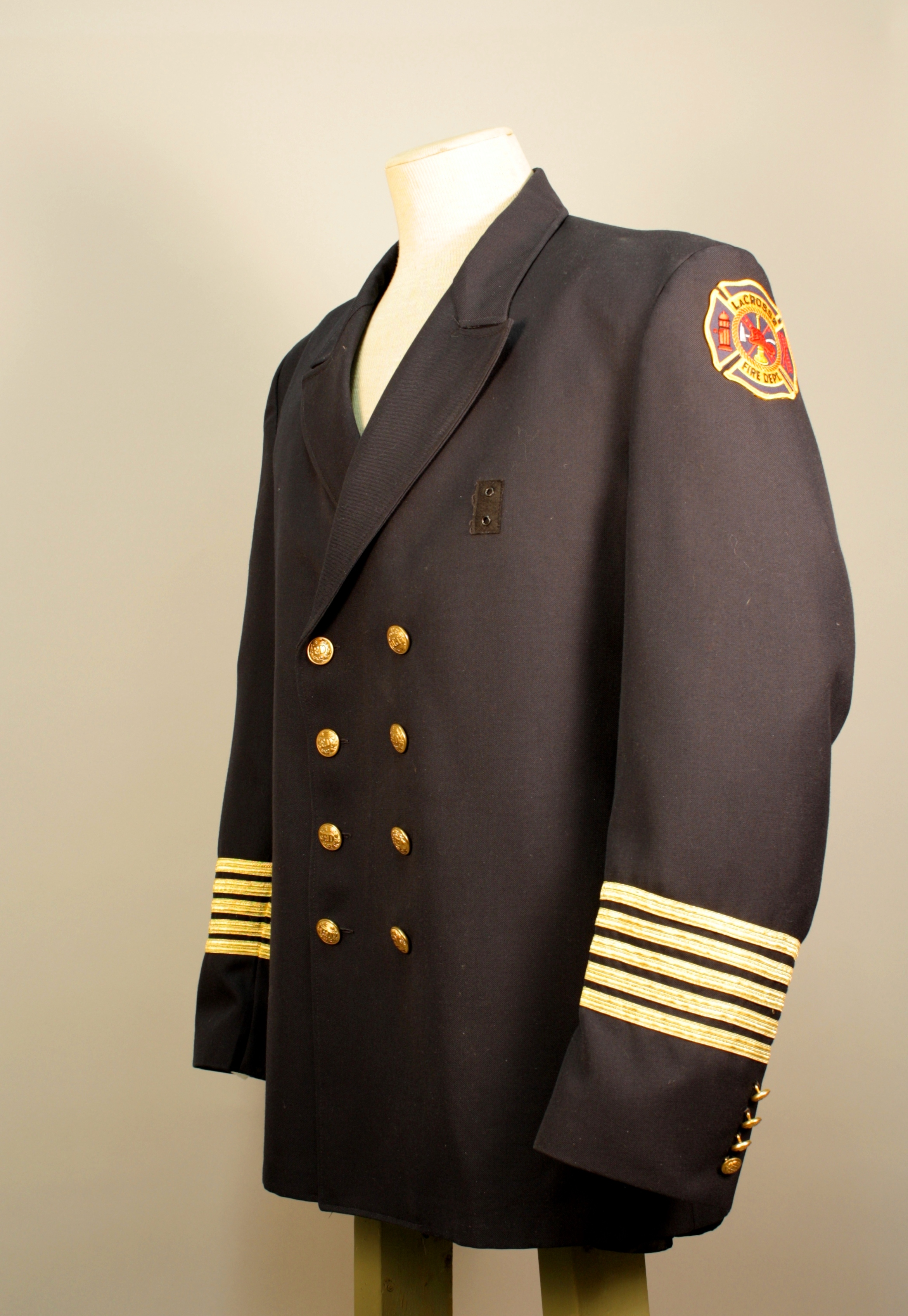
Fire Department Chief Gregg Cleveland’s Dress Uniform

Copyright La Crosse County Historical Society

Copyright La Crosse County Historical Society

By Peggy Derrick

Catalog Number: 2013.001.01

The La Crosse County Historical Society usually accepts old items that are already a part of local history, for inclusion in our artifact collection. But occasionally we accept something newer that we feel will be of value and interest to future generations. This dress uniform falls in that category.

Gregg Cleveland, Chief of the La Crosse Fire Department, donated this firefighter’s dress uniform in 2013. It arrived in my office as if by magic, just appearing one morning, with a note in the pocket. No museum is a fan of “drop offs,” or abandoned property, but when I saw the uniform’s provenance, I reconsidered.

I have always wished we had more examples of very early uniforms from the police and fire departments: maybe someday this uniform will be of as much interest as an 1890 uniform would be today?

Therefore, this uniform, once worn by the 11th chief of the LCFD, is now in our collection. One very interesting thing about it is how similar it is to the uniforms worn by earlier fire chiefs. It is still navy blue wool, double-breasted, with fancy metal buttons showing the crossed bugle insignia. Really only the content of the material—a polyester lining, and some nylon mixed with the wool, identify this as a uniform from the second half of the 20th century, and not the late 19th century.

While the working uniform of a contemporary fire fighter is entirely different in look, material and functionality, from one 120 years ago, the dress uniform intentionally harkens back to the traditional role and look of a firefighter.

In 1877 La Crosse had four firemen on the city payroll, who oversaw the four main volunteer companies of firefighters. The first Chief, C. A. Hunt, was a strong advocate of a paid fire-fighting force. He had come to La Crosse in 1886 and joined Rescue Hose Company N. 1. Hunt was appointed fire chief of the city in 1896 when, after many years of discussion, the city fire department became fully paid, with career fire fighters.

At that time there were 45 men in service, divided into five stations, each headed by its own captain. Today LCFD has 93 firefighters working out of four stations.

This summer Chief Cleveland will retire after eleven years as chief of the LCFD, and his uniform will be become that much more “historic.” The insignia patch on the left shoulder, for the La Crosse Fire Department, makes it an especially nice piece of local history. Now if only we had the badge that would have been clipped to the metal eyelet on the jacket breast…

This article was originally published in the La Crosse Tribune on January 7, 2017.  

This object can be viewed in our online collections database by clicking here.