The Purple Leona

Amy Vach

Copyright La Crosse County Historical Society

Copyright La Crosse County Historical Society

Catalog Number: 2018.015.02

A previous installation of Things That Matter has featured the Leona — an undergarment invented and produced in La Crosse by Leona Foerster Linker.

This week’s Things That Matter is a Leona that was repurposed with a splash of color.

The Leona is a 3-in-1 early 20th century women’s undergarment that combined three necessary women’s undergarments, the chemise (worn under the corset), bloomers and drawers into one convenient article of clothing.

A lady would put her corset on over the Leona, and then a corset cover, or camisole, and petticoats would be added.

Leonas came in various sizes and degrees of fanciness. Some were very simple, while others were trimmed with fancy laces and made of fine fabrics.

Although the garments varied in design, they were all white. The price of the undergarment ranged from $1 to $12, depending upon the material and degree of decoration: most Leonas cost about $2.

The Leona soon became obsolete as women’s undergarments and outfits drastically changed in the 1920s, and a minimum of three layers was no longer necessary.

About 50 years ago, the Leona pictured here found a second life on the beaches of Hawaii in the 1970s.

The Satory family purchased a box of brand-new Leonas at the Linker estate sale.

The Leonas purchased at the estate were along the lines of the company’s basic product and were trimmed around the neck and sleeves with a narrow band of lace. Christine Satory took the Leonas to Hawaii and tie-dyed them various colors. After they were dyed, she sold them as swimsuit cover-ups.

According to a sales catalog from the Leona Garment Co., the Leona is “wonderfully convenient — on and off in an instant.” This quality of the Leona made it an ideal swimsuit cover, for a generation that was unfamiliar with the article’s original purpose.

John Satory, brother of Christine, donated this purple Leona and a brand-new white Leona to La Crosse County Historical Society in 2018.

This article was originally published in the La Crosse Tribune on March 16, 2019.

This object can be viewed in our online collections database by clicking here.

*This article was updated on July 23, 2020.

The Hanscomes' Bed Warmer

Copyright La Crosse County Historical Society

Copyright La Crosse County Historical Society

Amy Vach

Catalog Number: 1956.005.10

Throughout these cold Wisconsin winters, I know that at the end of the day I can go home to a pleasant, warm house.

However, during the 18th and 19th centuries, it was not as easy to heat one’s home.

Homes were damp and the beds were cold.

This is where the bed warmer comes into action. This brass bed warmer once belonged to one of the city’s founding families, the Hanscomes. The Hanscome family came to La Crosse in 1853 from Maine.

This bed-warming pan functions along the same lines as my electric blanket.

Warmed stones, coals or smoldering ashes from a fire would have once filled this pan. The hinged lid is punctured by a decorative pattern of holes that allow oxygen to feed the coals and keep them hot.

Once the bed warmer was filled, it was inserted between the bed sheets and moved about to warm and dry the bed for a cozy sleep.

The person using the bed warmer needed to be cautious and aware of the surroundings so that the bed would not catch fire.

Bed warmers have existed for centuries, with some of the earliest examples dating back to Queen Elizabeth I. Early warmers were made of silver, copper or brass and looked similar to this warmer from the Hanscome family.

According to Annie Hanscome, the bed warmer was used by her maternal grandparents, Dr. and Mrs. Abraham Wendell Anderson in Gray, Maine, circa 1830.

The family was relatively well-to-do, and when Annie’s parents, Charles and Anna, came to La Crosse in 1853, they brought their prized family possessions with them. This warmer may have been used to help warm the beds in their family home in La Crosse.

Annie Hanscome was the last surviving member of her immediate family, and she made the home into a memorial to her family: It held many objects and furnishings accumulated and treasured by her family over the years.

In 1949, the La Crosse Tribune described her home as an historical family museum with objects dating to the Revolutionary War. Some of the objects were her parents’ wedding china, furniture and jewelry. Before her death in 1956, Annie Hanscome donated her treasured family mementos to the La Crosse County Historical Society.

This article was originally published in the La Crosse Tribune on March 14, 2019.

This object can be viewed in our online collections database by clicking here.

Homemade Ice Fishing Rod

Ivy King

Catalog Number: 2010.021.01

Copyright La Crosse County Historical Society

Copyright La Crosse County Historical Society

During these cold winter months if you are driving near or along the Mississippi river you see multiple shanties and people fishing on the frozen river. Ice fishing in La Crosse has been ongoing since before the European settlers came to the area. This week’s artifact, a homemade fishing rod, likely caught quite a few fish in the Coulee Region.

Ice fishing has a long history in this area. Indigenous people throughout the Midwest and across North America originally ice fished by placing a wooden decoy into their ice hole and then spearing fish through the hole. They used chisels to chip through the ice.  Later, Europeans utilized iron ice chisels in a variety of shapes and sizes as their technique of creating the ice hole until the mid-twentieth century.

Today ice fishing is a social activity, and modernity has only helped improve the technology of ice fishing. People have the option to use sonar units to help discover the location of fish, and they can use fast, powered augers to quicken the pace. Even with these advancements, ice fishers still utilize fishing rods.

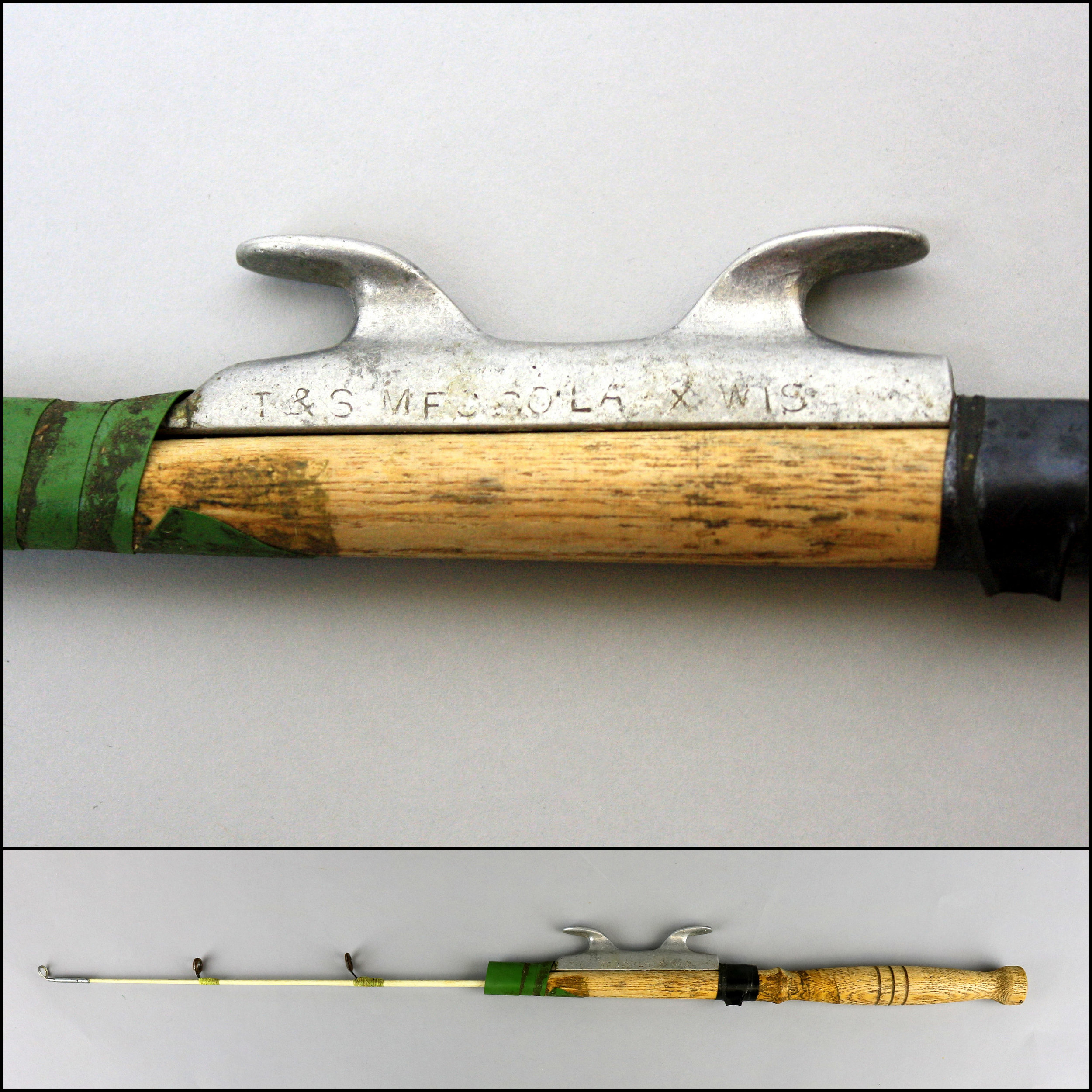
This homemade pole has been assembled with found materials. It is 22 inches long and has a wooden spindle for a handle, probably a piece of an old chair or tool. The tip of a fiberglass fishing rod, about a foot long, has been imbedded to the end of the handle. The creator of this fishing pole then used electrical tape to fasten a metal cleat onto the handle to hold the extra line. The cleat is stamped with “T&S MFG CO LAX WIS.” The “T&S” likely stands for John Torrance and Son Foundry, a local business begun in 1876 and is still in operation today.

Unfortunately, the pole was dropped off anonymously at the historical society, and we do not know the maker of this cobbled together ice fishing rod. But his or her ingenuity is certainly admirable. The pole represents a beloved winter sport that has stood the test of time.

This article was originally published in the La Crosse Tribune on March 2, 2019.

This object can be viewed in our online collections database by clicking here.