Marianne Bussell's Tea Cozy

Amy Vach

Catalog Number: 1974.007.04

Copyright La Crosse County Historical Society

Copyright La Crosse County Historical Society

Nowadays we use our cozies, or “coozies,” to keep things cold, not warm, and they are usually found insulating a can of beer or pop. But it was not always so.

A tea cozy is a thickly padded cover placed over a teapot to keep the contents warm.

During the late 1800s, fashionable homemakers of the Victorian era who had leisure time were obsessed with covering and decorating almost every surface in their homes. Often beadwork was incorporated onto various domestic items such as fire screens, cushions, and tea cozies. This week’s artifact is an example of this trend in La Crosse, an intricately beaded tea cozy.

Marianne Bussell made this tea cozy circa the 1860s in La Crosse; she and her husband Winthrop lived in La Crosse County for over 30 years. Winthrop worked on and off for the lumber business, and later in life dealt with fancy horses. The Bussells had one child who died in infancy.

This tea cozy was likely made from a pattern featured in a women’s magazine. It is decorated with thousands of glass and steel beads arranged to create a grapevine and floral motif. The interior is lined with a thick tweed fabric, and there is wool stuffed in between for insulation.

Women’s magazines and books provided the homemaker with guidance for proper etiquette for all social aspects of life. In one book, Manners and Tone of Society, or Solecisms to be Avoided (1897), tea cozies were described as being a “thing that should never be seen in a lady’s drawing-room.” The book further states that hostesses utilizing a tea cozy display a lack of wealth. According to this publication, if the tea turns cold, a hostess should merely ring for fresh tea for her guests.

While the guide suggests otherwise, tea cozies were popular, and generally considered a practical device before the invention of insulated teapots and microwaves. Tea cozies like this one would have been saved for special occasions and used with the best silver or porcelain teapot in middle-class homes. The lining is stained, suggesting that Marianne Bussell, or possibly one of her family members, may have used it while entertaining guests.

Teapots are not the only things that could be kept warm with a cozy cover: the egg cozy is a tiny version designed to top a boiled egg and keep it warm. These could be knit or woven, and were often imaginative and playful in design.

The Bussell’s grandniece, Helen Hestad, donated this tea cozy and other items from the couple to La Crosse County Historical Society in 1974.

This article was originally published in the La Crosse Tribune on February 2, 2019.

This object can be viewed in our online collections database by clicking here.
Jackie Kennedy Paper Doll

Ken Brekke

Copyright La Crosse County Historical Society

Copyright La Crosse County Historical Society

Catalog Number: 1984.041.02

The glamour associated with Jacqueline Kennedy never seems to go out of fashion.

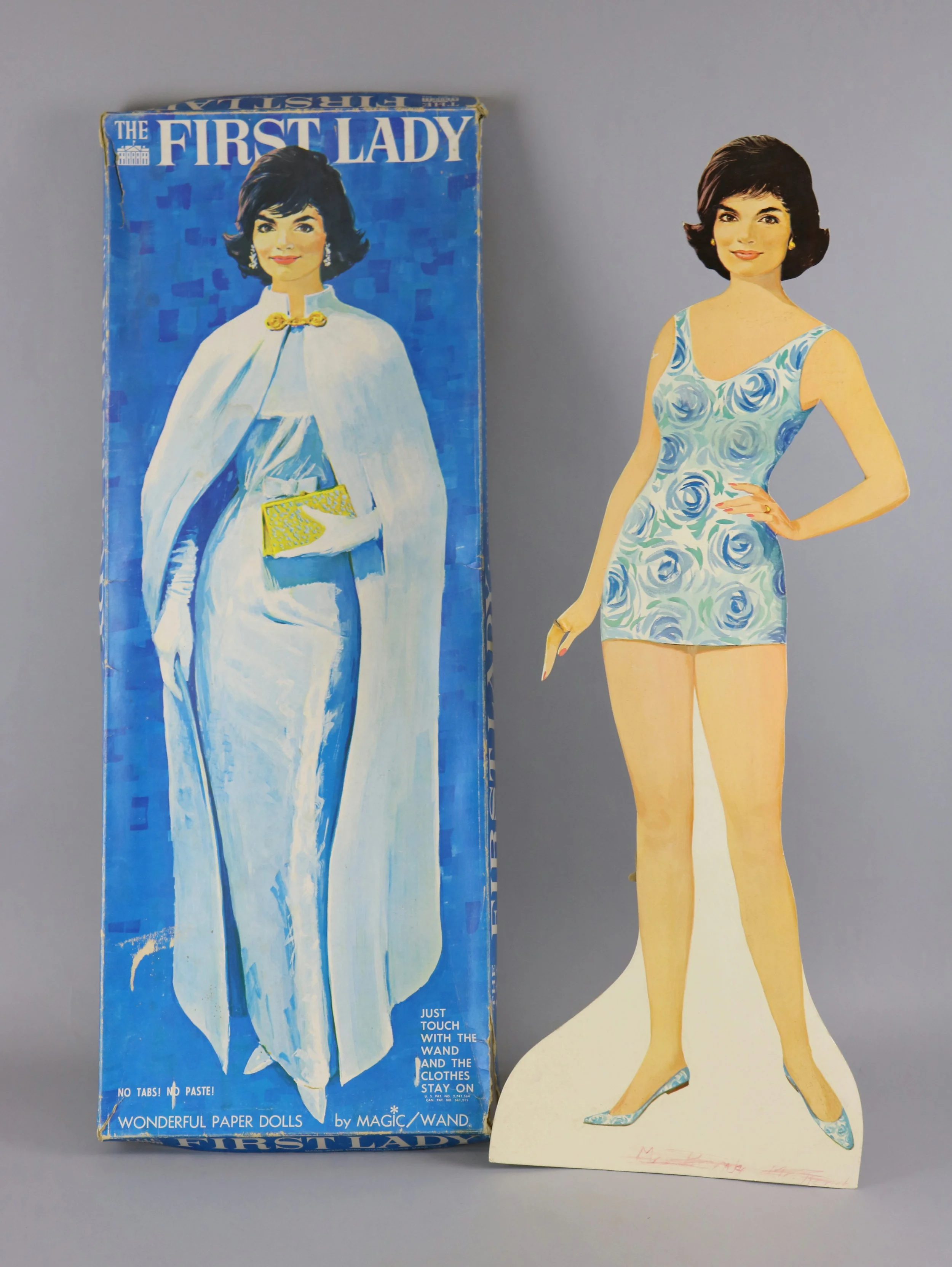
This Jackie Kennedy paper doll set, donated by Virginia Larkin of La Crosse, is part of the La Crosse County Historical Society's collection from the '60s.

Even now, nearly 25 years after her death, the former first lady’s reputation for style, elegance and grace is intact.

The Magic/Wand Corp. of Charlestown, Mass., was among the first companies trying to take advantage of that Kennedy magic when it produced a Jackie Kennedy paper doll in the early 1960s.

Virginia Larkin of La Crosse paid a dollar or two for that paper doll, probably sometime in 1962. The cardboard figure stands nearly 30 inches tall, and the folding support that props the cutout up provides a 10-inch diameter base when the doll is in its standing position.

The “First Lady” doll set, donated by Larkin to the La Crosse County Historical Society in 1984, marks Jackie’s term as First Lady, from January 1961 until the assassination of her husband, John F. Kennedy, in November 1963.

The doll set includes a wide variety of skirts, pants, blouses, hats, shoes, coats, purses and other accessories.

Rubbing the back of the clothing with the set’s plastic wand triggered an adhesive reaction that caused the clothing to stay on the cardboard doll.

The Kennedy family inspired several other paper dolls, and cutouts featuring Jackie and first daughter Caroline apparently were especially popular, judging by their availability on websites today.

An evening dress, riding habit and fur coat are among the more elegant pieces that came with the doll, but a replica of the pink suit the first lady was wearing when her husband was shot in Dallas is not among the collection of outfits in the box.

The tragedy-touched original suit was donated to the National Archives in Washington, D.C., by Jackie herself shortly after the assassination. The suit, stained with her husband’s blood, remained her property, though it has been stored in the National Archives ever since in an acid-free box in a climate-controlled vault. Ownership of the pink suit, which has never been cleaned, passed to Caroline Kennedy when her mother died in 1994.

The daughter donated the suit to “the people of the United States” in 2003, with a stipulation that it can’t be publicly displayed until 2103, and then only after the Kennedy family has granted permission. It has yet to be exhibited. The outfit’s matching pillbox hat was not part of the clothing turned over to the National Archives and has disappeared.

This article was originally published in the La Crosse Tribune on January 26, 2019.

This object can be viewed in our online collections database by clicking here.
1960s Record Player

Robert Mullen

Catalog Number: 1990.075.02

Copyright La Crosse County Historical Society

Copyright La Crosse County Historical Society

Vinyl records are experiencing a surprising resurgence in popularity in the twenty-first century. Considered an obsolete technology for some thirty years, audiophiles are returning to LP (Long Play) vinyl records because they consider their sound to be warmer and richer than digital versions. Over ten million vinyl recordings were sold in the U.S. last year, but these sales don’t come close to meeting the numbers of fifty years ago, when vinyl was supreme.

Most homes of the 1960s had a record player, either a large console cabinet or a smaller portable player. Some young people, however, wanted to take their music with them when they were away from home with friends. Like most American teenagers, they needed to express some independence, to listen to the music of their choice without parental oversight. Manufacturers saw a demand for a mobile device and began to offer battery-operated record players for sale.

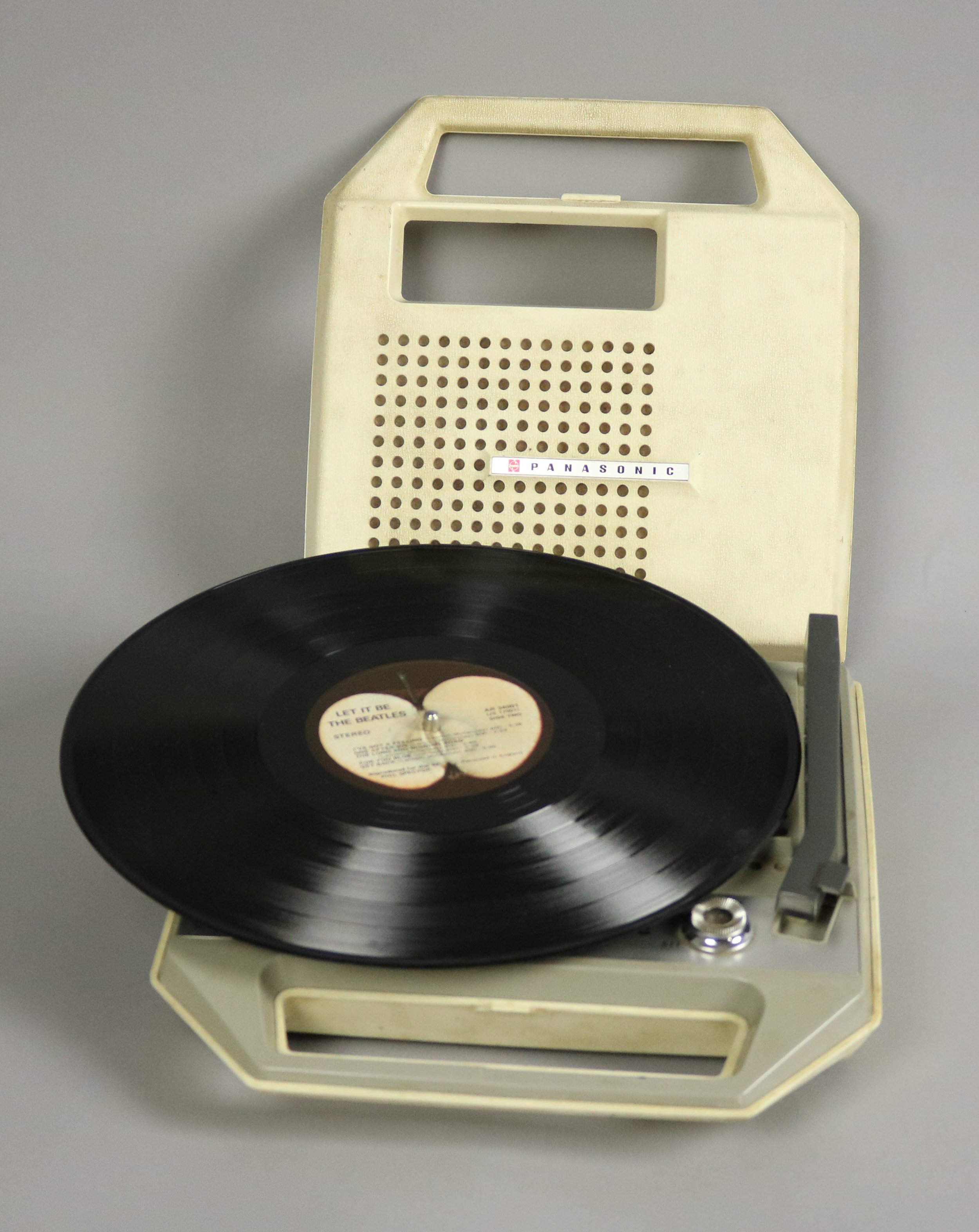
The player shown here is a small, lightweight Solid State Panasonic SB-330 that dates to about 1968. Its plastic case measures eleven by twelve inches including a molded carrying handle. It ran on six C batteries and could play 33 1/3 and 45 r.p.m. (revolutions per minute) vinyl records. In the late 1960s, some of the most iconic music of the era were likely played on this record player: songs like the Beatles’ “Hey Jude,” Otis Redding’s “(Sittin’ on) The Dock of the Bay,” or Simon and Garfunkel’s “Mrs. Robinson.”

While this machine required manually placing a single vinyl record on the turntable, other models were designed to stack several records on a spindle, dropping a new record when the previous one finished playing. This record player enabled its young owner and friends to listen to the latest hits wherever they went, to the beach, the park, or the back yard. The sound quality of this machine, with its small built-in speaker, would likely not satisfy today’s audiophile.

This battery powered portable record player was donated to the historical society by Corinne Martell in 1990.

This article was originally published in the La Crosse Tribune on January 19, 2019.