Cabbage Cutter

Caroline Morris

Catalog Number: 2008.019.01

image-asset.jpeg

The only thing better than daydreaming about the spring garden is daydreaming about the first fresh-from-the-earth harvest.

You determined souls who start your own seeds may be getting ready to sprout cold-weather crops like cabbage. If, down the road, you find yourself with more cabbage than you know what to do with, grab one of these handy “cabbage cutters” and make a huge batch of sauerkraut to be stored and savored throughout the year. This is what the Bohemian and German immigrants to this area did to preserve their harvest, just as they had in the old country.

The three metal blades on the cabbage or “kraut” cutter from the La Crosse County Historical Society’s collection would make quick work of a full head of cabbage. This particular cutter, made by Tucker and Dorsey Manufacturing Co. in Indianapolis, included a small wooden box that slid up and down over the blades. The enterprising home cook would put a cabbage head in the box and run the box repeatedly over the blades until the cabbage had been reduced to shreds.

The cook would then layer the cabbage with salt in a huge crock, and weigh the whole thing down with a heavy object. (If you’ve ever found an enormous lake stone in your grandparents’ basement, this might be why.) After that, it’s only a matter of waiting for the cabbage and salt to ferment into that tangy slaw we all love to eat with our Oktoberfest brats.

The donor of this cabbage cutter, Marian Schnell, wrote on her donation form: “This belonged to my mother-in-law, Mary Jirocek Schnell. She got it from her mother, Barbara Martinek Jiracek. Last time it was used was the fall of 1972.”

This article was originally published in the La Crosse Tribune on March 21, 2015.

This object can be viewed in our online collections database by clicking here.

Pershing Boots

550347de0eb75.image.jpg

Catalog Number: 1982.044.05

Now that mud season is (happily) upon us, have you dug out your best waterproof boots? If last year’s galoshes won’t cut it, consider finding a pair of Pershing boots, like the ones in the La Crosse County Historical Society’s collection.

“Oh the ruddy mud, the muddy mud, the mud that gets your goat,” wrote Corp. Jack Warren Carrol in a May 1918 edition of The Stars and Stripes. When American forces got to France in 1917 during World War I, they quickly found themselves marching, sleeping and fighting in mud.

Battlefields covering dozens of square miles turned into oceans of mud, and men and machines had to slog through it for months on end. U.S. infantry troops quickly discovered that their boots were not up to the task, largely because the leather uppers were not waterproof.

We can presume that having cold, wet feet for several days or weeks at a time did nothing for morale. But more importantly, the damp boots were ripe environments for the development of “trench foot,” a medical condition that at best hinders a soldier’s fighting ability, and at worst results in amputation.

In January 1918, Gen. John J. Pershing, commander of the American Expeditionary Forces, personally cabled the War Department to request a new boot. The result was the Pershing Boot, a larger, sturdier and more waterproof model. Impressed by their size and effectiveness, soldiers called them “Little Tanks.”

Many years ago, a Wisconsin soldier must have brought these boots home with him. After all, if the Pershing boots could stand up to the muddy fields of France, they should be able to handle a Wisconsin spring.

This article was originally published in the La Crosse Tribune on March 14, 2015.

This object can be viewed in our online collections database by clicking here.

'Humphreys’ Specifics'

Caroline Morris

Catalog Number: 2011.fic.298

2011.fic.298.JPG

If you stopped in a La Crosse drug store around the turn of the century, you might have found a medicine cabinet filled with “Humphreys’ Specifics” — little white pills and vials promising you relief from the many ailments that can afflict you this time of year.

A list on the front of the green metal cabinet door promised to cure the patient of 35 separate ailments, including fevers, headaches, croup or “general debility.” Inside are little drawers with corresponding number. The packets of pills went for 25 cents each, unless you suffered from “nervous debility” or “diseases of the heart,” in which case you would have to pony up a whole dollar.

The homeopathic pills, developed by Dr. Frederick Humphreys of New York, proved popular in the Midwest, judging by advertising campaigns. The pills were supposed to illicit symptoms similar to the disease, thereby prompting the body to take action and “cure” the disease itself.

If a potential customer was dubious, an advertisement that ran in the Eau Claire Evening Free Press in March 1900 reassured readers that the pills “act directly upon the disease, without exciting disorder in other parts of the system.”

After having taken the pills, if you felt they had been effective, you could send away for similar cures for your horses and dogs. The medicine cabinet in the La Crosse County Historical Society’s collection unfortunately does not including pricing information for the veterinary medications.

This article was originally published in the La Crosse Tribune on March 7, 2015.

This object can be viewed in our online collections database by clicking here.

'Kiddie Club' Radio Show Booklet

201201401.jpg

Caroline Morris

Catalog Number: 2012.014.01

In 1938, each weekday at 5:30 p.m., proud parents could tune in to radio station WKBH to hear their children perform on “The Kiddie Club,” a variety show sponsored by the Erickson Bakery of La Crosse.

The “Juvenile Players” sang, told jokes, and even wrote and directed their own “jolly plays” for the program, which was overseen by Lorraine Neumann and “Uncle Dave.”

In a case of art imitating art, local teenager Eddie Koops wrote and directed a comedy skit in June 1938 at the Riverside Park band shell, showing the citizens of La Crosse what actually happened in the radio room while the kids were broadcasting a play.

With the script lost to history, we can only guess at the antics. The radio show was popular enough that when WKBH launched a TV station, “The Kiddle Club” made the jump, this time with “Uncle Ken.”

This article was originally published in the La Crosse Tribune on February 28, 2015.

This object can be viewed in our online collections database by clicking here.

Portrait of Early La Crosse Settler

Catalog Number: 1943.100.02

194310002.jpg

This painting, signed by Charles Waldo Jenkins (1821-96) and dated 1848, is of Fredericka Augusta Levey (1820-90).

“Gussie” and her husband, John, came to La Crosse in 1846 when the white settlement of Prairie La Crosse consisted of a smattering of crude log homes along the riverbank. They opened a store attached to their house, which also served as La Crosse’s first hotel.

Augusta and John welcomed and assisted new settlers, ran the post office and opened their home for church services for several denominations. During the frequent times when John was away trading, Augusta ran the store and hotel.

The couple embodied the spirit of community building in the earliest years of La Crosse. Her memories of life in Prairie La Crosse were preserved through an interview, conducted in her native German, by a grandniece when Augusta was in her 80s. The first published histories of La Crosse included information from the memoir, often without recognition for the author.

Gussie’s memoir remains a valuable historical document of life in early La Crosse.

This article was originally published in the La Crosse Tribune on February 21, 2015.

This object can be viewed in our online collections database by clicking here.

Homemakers Club Quilt

201100401.jpg

Peggy Derrick

Catalog Number: 2011.014.01

An organization like the Homemakers Club in Barre Mills was a part of the fabric of rural communities, building relationships and creating ties that broadened women’s lives beyond their families and churches. Women enjoyed creating this signature quilt as they built community while stitching together. The Homemakers Club in Barre Mills made this quilt, which was given to either the mother or grandmother of the donor, Vernetta Fish.

The quilt has 16 blocks, mostly wools and other clothing fabrics. Names of club members, and their birthdates, are embroidered all over the quilts, along with the inscription: Homemakers Club, Jan. 10, 1924. Individual patches are outlined with colorful embroidery stitches in a variety of different stitches. Backing is flannel, dark pink with a floral print.

Homemakers Clubs were incorporated into the Wisconsin Extension program in 1939, with a mission to provide demonstrations to local groups of rural women across the state. Over the years, topics ranged from safe canning of garden produce to how to use a computer.

This article was originally published in the La Crosse Tribune on February 14, 2015.

This object can be viewed in our online collections database by clicking here.

Wrapping Paper Offers Trip Back In Time

2012fic157.jpg

Catalog Number: 2012.013.01

This Thing that Matters from the artifacts of the La Crosse County Historical Society seems so simple. But it conjures memories of a time when purchases were wrapped in paper pulled off from a 12-inch roll in local stores and then tied with string. Shoppers put each purchase into their own shopping bag.

This wrapping paper with its red fleur-de-lis and black design on off-white paper was a form of advertising. Note the words: “La Crosse’s Leading Prescription Pharmacy” and: “Prescription Headquarters, complete liquor and cosmetic departments, school supplies, greeting cards, wheel chairs, etc.”

Frank Hoeschler was a dentist in partnership with his brothers in the pharmacy at Fifth Avenue and Main Street. Later, he turned into a real estate developer, changing Fifth Street into Fifth Avenue, making it into the premiere shopping area of La Crosse. He even brought in the first national retailer to La Crosse — Montgomery Ward.

Hoeschler was a visionary in all but one area – he once suggested filling in the La Crosse River Marsh to unite La Crosse’s North Side and South Side. That never happened, of course.

This article was originally published in the La Crosse Tribune on February 7, 2015.

This object can be viewed in our online collections database by clicking here.
Paper Fastener Didn't Replace the Stapler

198513301+%282%29.jpg

Catalog Number: 1985.133.01

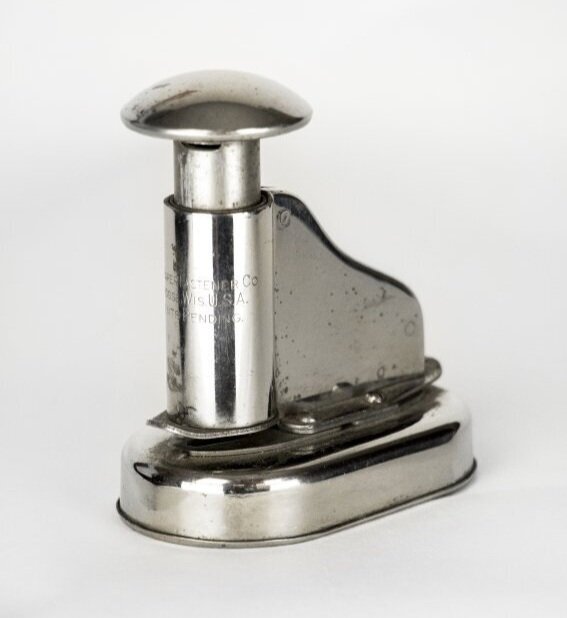
When he formed his company in 1905 as the Bump Paper Fastener Co., George P. Bump of La Crosse was convinced he’d make a million dollars on a stapler that didn’t require any staples.

It didn’t happen, but his 4½-inch metal paper fastener is a marvelous little office tool that punches a triangular hole and folds over the little cut-out tabs.

Note the maker’s name is stamped into the front of body of puncher: “Bump Paper Fastener Co., La Crosse, Wis, USA, Patents Pending.” Walter Woods donated the fastener to the La Crosse County Historical Society in 1985.

The company was reorganized in 1927 as the Bump Manufacturing Co., and in 1930 the company was changed to the Bump Pump Co., based on a pump he invented. Bump died in 1947, and by then the company made a line of equipment of chemical, oil and dry cleaning pumps, and specialized pumps for certain industries.

The company was located at 1820 West Ave. S., where the Pepsi-Cola buildings are today. In 1956, the company was sold to the Ulrich Manufacturing Co. of Roanoke, Ill.

This article was originally published in the La Crosse Tribune on May 12, 2018.

This object can be viewed in our online collections database by clicking here.